Showing posts with label Graphic Novel. Show all posts

Saturday, July 5, 2014

Should Have Been Titled "The Grift"

The Griff
Written by Christopher Moore and Ian Corson
Illustrated by Jennyson Rosero
Published by HarperCollins Publishers
1 Out of 5 Stars


Hey, Michael Bay, I found your next movie concept! And you can't screw this one up because it comes pre-fucked. Inexplicable, ridiculous threat to humanity? Check. Shallow characters? Check. Nonsensical plot with holes big enough to drive Optimus Prime through? Check. Cliche action dialogue? Check. Females who offer little more than T & A? Check and check. 

Now, where do I go to pick up my finder's fee?

I love Christopher Moore's novels. His zany sense of humor, hilarious dialogue, and obvious compassion for his fellow man is a combination that I find irresistible. But, hole-e fucksocks, The Griff is no Christopher Moore novel and, to be fair, that's established up front in Moore's preface (which also happens to be the best part of the book). Essentially, Moore came up with this idea that he thought would work well as a movie, he and a buddy (Ian Corson) wrote the script as a way of avoiding real work, and then tossed it in a drawer because they knew it would never be picked up as a film. Then the comics came calling and Moore remembered The Griff screenplay and brought it back into the light as a graphic novel.

And he should have left it in the dark. While I have no doubt that Moore and Corson had a hoot writing it, it's a hot mess. There's no sense of time (entire weeks pass with no clear signal to the reader, making it seem as though everything happens in the course of a day); the artwork is pretty, but inconsistent and the panels are often confusing (one gets the sense that there were lots of blanks in the plot that they decided to quickly "flesh out" with artwork that has no real sense of narrative direction); and it follows the standard summer action flick formula so faithfully that it offers nothing new. It reads like a screenplay with pictures and has a rushed "Wham, Bam, No-Thank You, M'am" feel to it." 

A plot this ridiculous (giant alien dragons show up out of nowhere and wipe out most of mankind) could have been fun if it had been more of a spoof or featured more of Moore's signature humor. There are a few bits of dialogue that are pure Moore and, while hilarious, still not worth the price of admission.

My advice? Read Moore's FoolA Dirty Job, or Fluke and give The Griff a pass. 

Sunday, April 14, 2013

Someone Forgot to Add the "Dark"

Justice League Dark:  The Books of Magic (Volume 2)

by Jeff Lemire

Illustrated by Mikel Janin

Published by DC Comics

2 1/2 Out of 5


I really wanted to like Justice League Dark, but the irony is that it just wasn't as, well, dark as I wanted it to be. Maybe that was an unfair expectation on my part, but with John Constantine in the lead I was really hoping for a more mature plotline and something a little grittier. In the end, it's a fairly conventional storyline that kind of plods along without gaining any real momentum. The keys to the legendary Books of Magic have been discovered, bad guys want them, good guys want to stop them, John Constantine may or may not be a good guy as he might just covet the books for himself . . . yawn.

Also, so many characters weave in and out of the narrative in a completely transparent attempt to lure readers into other series that none of them are actually there long enough to be fully developed or fully utilized. I was initially drawn to the series because Andrew Bennett was being introduced to the team, but he pops in and out with such underwhelming results that I could go for an issue or two and completely forget of his existence until I saw an asterisk with "Check out issue # of I, Vampire for this exciting storyline!" When Amethyst from Sword of Sorcery* checks in, I decided I was ready to check out of this series.


*(I've never read Sword of Sorcery, but the covers smack a little too much of She-Ra, Princess of Power, to pique my curiosity. Way too much pink and purple happening there.)

Saturday, April 13, 2013

Not Exactly a Ragin' Cajun

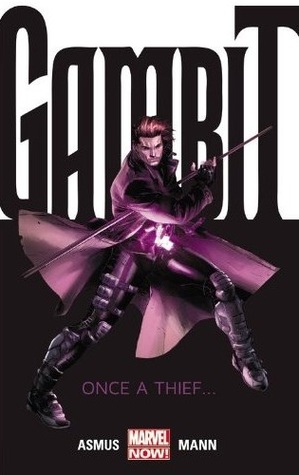
Gambit:  Once a Thief

by James Asmus

Illustrated by Clay Mann

Published by Marvel

3 Out of 5 Stars


Oh, Remy LeBeau, why can't Marvel let you be a truly dastardly scoundrel these days?

One of the reasons I like Chris Claremont's Gambit is because he truly walked the line between good guy and bad guy and, in Howard Mackie's The Tithing story arc, we learned about a complex past steeped in the back alleys and shadows of New Orleans. To me, the best Gambit is an unapologetic thief whose wit and devil-may-care attitude make us forgive--but not forget--his shortcomings. What I don't enjoy is a Gambit who steals only because it's an itch that needs to be scratched--but, hey, no real harm done because it's always from some bad guy, he never really wanted the said object any way, and by stealing said object he creates the means by which he can heroically save the day. All the while he cracks a few obvious jokes that stand in for any real wit or charm. The Gambit-lite of John Layman doesn't particularly interest me.

And neither does the one presented by James Asmus. This Gambit does have some promise, but is ultimately predictable. Gambit's bored these days and just wants to stretch the old sticky fingers and see if he still has the ability to walk out of some place with something that isn't his. His target is the home of a supervillain and his outing brings him into contact with a femme fatale who looks like a Laura Croft rip-off with tattoos. He, of course, steals what she wants, they team up (but have trust issues), there's undeniable chemistry, he saves her, she betrays him, yadda, yadda, yadda.

If there's a character ripe for a mature storyline, it's Gambit. Frankly, I want a Gambit who is a bastard. There should be womanizing, honest-to-God stealing because he wants something of value that's not his (and no rhapsodizing on the supposed romance of thievery), gambling with cards and with lives, voodoo, betrayal from his end instead of someone else's, and maybe a few bodies left in a bayou.

I am sticking with the series, however, because there are flashes of promise. I enjoyed the realistic art work which shuns the cartoonish look that was my biggest problem with the John Layman series. Also, there are genuine flashes of humor and, while it does lean too heavily on internal monologue to move the story forward, Gambit's voice hits the right tone for me. And, best of all, THERE'S NO ROGUE (a character that I liked in the 90's, but that storyline's been done to death). Hopefully, now that we've got the pre-requisite heist story arc out of the way, Asmus might take this into some more intriguing and unexpected directions.

Monday, April 8, 2013

You Can Run, But There's Nowhere in the Universe to Hide

Saga

by Brian K. Vaughan

Illustrated by Fiona Staples

Published by Image

4 Out of 5 Stars

How to describe Saga? It's like someone took Firefly, coated it liberally in WTF, and sprinkled a little Quentin Tarantino on top. Yeah, it's some wonderfully messed up stuff.

The planet Landfall is at war with one of its moons, known as Wreath. The indigenous people of Landfall seem reliant on technology and sport some nifty little insect-like wings, while the people of Wreath have horns (they may be my favorites, as each of the characters in the later issues have horns varying from rhino, to antelope, to ox) and are adept at magic. The war between these cultures has become an accepted part of life, the hatred of the enemy deeply ingrained in both species.

Now enter Marko and Alana, from Wreath and Landfall, respectively, who are ex-soldiers in this war. Defying their cultures, they have fallen in love and the birth of their newborn child, Hazel, has marked them for termination by basically everyone in the universe. Both have known violence and are adept at using it to protect each other and Hazel. On the run from the numerous assassins tracking them, they banter away like a married couple and slowly reveal the history that brought them to this juncture.

And now for a convenient list of the absurdities that await the Saga reader, so you can gauge whether or not the "WTF" element is acceptable to you:

--a planet known as Sextillion that specializes in, you guessed it, sex
--prostitutes that consist of giant heads teetering on top of Rockette style legs
--a forest that actually grows rocketships
--a race of robots that have television screens for heads
--graphic sex scene featuring the aforementioned robots
--a topless assassin with the torso of a human (sans arms) and spider legs (all the better for gripping multiple weapons with) concealed beneath a ballgown style skirt
--the ghost of a teenage girl who must have suffered a gruesome death as she's nothing but hanging intestines from the waist down; naturally, she tags along as Hazel's "babysitter"
--and LYING CAT; my new favorite comic book character is a giant feline sidekick to The Will, one of the assassins contacted about offing Marko and Alana.  Lying Cat can detect whether or not others are engaging in a bit of creative truth telling and immediately reveals the falsehood to anyone within earshot

While the base storyline is one we've read before, the execution is unlike anything I've ever read. Vaughan gleefully injects new and intriguing absurdities into the premise and it's really difficult to get a fix on where this sucker is going--but that's part of the great thing. The ride is so much fun that I really don't care. The artwork by Fiona Staples has a raw and edgy quality that suits the storyline perfectly.

I've been getting the monthly issues, which have the added benefit of a letters section in which Vaughan responds to reader letters. The results are often hilarious and I find myself looking forward to this section with the same anticipation I look forward to the storyline.

Vampires that suck and a narrative that doesn't


American Vampire:  Volume 1

by Scott Snyder and Stephen King

Illustrated by Rafael Albuquerque

Published by Vertigo

4 Out of 5 Stars

I've always loved vampire narratives, but these days I feel as though I have to make that statement with a "but not those sparkly Meyers' bullshit vamps" disclaimer because the term "vampire" now requires two definitions: 1) glittering and eternal boy band wannabe who tries to protect naive (and horny!) young women from the monster he's become while slurping up woodland critters like they're Hi-C fruit boxes, and 2) vampires who seduce and cruelly toy with their prey before ripping open a jugular and letting someone else worry about the clean up. When it comes to vampires, I'm more of a "Team Kill" than "Team Brood." I tell you all of this to say that I really enjoyed American Vampire, which returns vampires to their more horrific origins: the single-minded drive of a predator coupled with human intelligence. Nothing is more terrifying.

The story is actually two intertwined narratives: the story of Skinner Sweet, a ruthless outlaw in the twilight of the Old West, and Polly, a Hollywood extra in the 1920's. Until Skinner is accidentally turned, vampires in America consist of Old World European vampires who have come to the United States to feed on the economic boom, as well as the unsuspecting populace. With Skinner's creation, a new kind of vampire is brought into being: one who can walk during the day and who is not susceptible to the weaknesses of the generation that came before him. It turns out that, with each new vampiric creation, a new and unpredictable strain of vampirism comes into being. Therefore, the European vampires jealously guard their "gift" lest they create a breed that can eventually overthrow them. This plot twist promises for rich and varied narratives as we follow these vampires into future storylines; Skinner creates Polly, a vampire whose powers mimic Skinner's but may ultimately eclipse his.

Of the two storylines, I preferred the Stephen King narrative about Skinner Sweet, but I'm a sucker for the Old West. However, it was a close call as Snyder's tale is equally intriguing and Polly is definitely one badass mamma-jamma.

While not quite as violent as I expected, Snyder and King have definitely given a tired genre a new life with plenty of subtext about American innovation versus European traditionalism. So keep the anemic Edwards of young adult narratives. From now on, I'll take my vampires like I take my tea--Sweet, please.