Showing posts with label Bloodsuckers. Show all posts

Thursday, January 30, 2014

Tea and Tedium

A Discovery of Witches
by Deborah Harkness
Published by Viking Penguin
1 Out of 5 Stars


In A Discovery of Witches, we clueless humans have no idea that we share our world with witches, vampires and daemons (creatures whose manic bursts of creativity result in some of the world's greatest artistic works). Isn't that exciting? One would certainly think so. So, what kind of shenanigans does this preternatural lot get up to while we live our ordinary lives?

Well . . .

Behold the books that shall be read! Thrill to the revelation that trips to the library will be made time and time again! Gasp as cups of warm tea are made and consumed! Swoon as vampires are repeatedly described as smelling of baked goods! And grip the edge of your seat for the most bizarre yoga-scene in the history of the written word!

That's right, folks. Vampires, witches, and daemons aren't like you and me--in fact, our lives are infinitely more interesting than theirs.

Seriously, what the hell is this? The best I can tell is that it's Twilight for grown-ups. And I can't believe I'm going to say this, but here it goes: Twilight is better. Suddenly vampires playing baseball during thunderstorms seems down right genius compared to vampires attending a supernatural yoga class. You want to drain all the sex appeal right out of your vampiric leading man? Just mention him doing some peculiar yoga move where he seems to be holding himself up vertically from the floor by nothing but his ear.

And then prattle on about how he's cold. And always has his hands stuffed in his charcoal trousers. And gets ridiculously enraged every time someone mentions blood because . . . he . . . might . . . not . . . be . . . able . . . to . . . control . . . himself (despite living a relatively normal life around humans for 1,500 years and seeming to need little in the way of sanguine sustenance). And how he maintains control of himself by always grasping the talisman he wears beneath his some-shade-of-grey sweater. And then have him ply the witch he is inexplicably drawn to with hundreds of bottles of wine and query her as to what every single one tastes like.

Oh, ho! And the witch! Now there's a live wire! Diana Bishop spends her days running, rowing, yoga-ing (?), and reading. Oh, and never using her magic because she wants to be just like us. Well, actually, she does use her magic every now and then, but only when it's really important. Like fixing her washing machine or getting a book off of a really high shelf. But other than that, it's all ixnay on the magic-ay.

At 200 pages in, I decided I couldn't stomach it any more. After all, up to that point, I had already been treated to a baker's dozen of the same basic scene:

--Diana goes to the library

--creatures are there; they pretend to read so they can watch her read all day, but they do so in a really creeptastic and menacing way, man

--Matthew, the vampire, goes to the library and pretends to read so he can watch them watching her watch a book and protect her in case one decides to, oh, I don't know, nick her with a really nasty papercut or something

--Diana and Matthew later go and consume a meal and beverages and talk ad nauseum about food to the point where an epicurean would offer them both a hot cuppa shut the fuck up

--Matthew will get angry with Diana, she'll apologize, and he'll settle his ass down

Round and round they go, where do they stop? Nobody knows! Oh, wait. I do! At the library! It's like freaking Groundhog Day without Bill Murray. And Groundhog Day ain't shit without Bill Murray. And neither is A Discovery of Witches.

When I decided I had a life to live, Matthew was fervently explaining how daemons, witches, and vampires might be going extinct!

To which I can only ask, so what's the problem?

Sunday, January 12, 2014

A New Red Scare

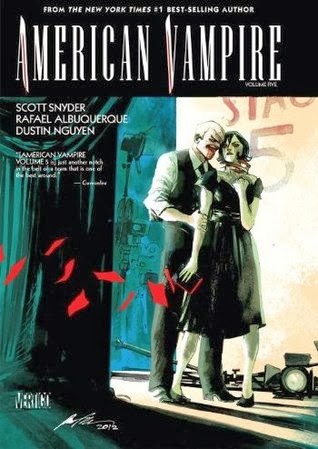
American Vampire:  Volume 5
Written by Scott Snyder
Illustrated by Rafael Albuquerque and Dustin Nguyen
Published by Vertigo
4 Out of 5 Stars


As usual, Scott Snyder's American Vampire continues to kick ass with its gritty, unique take on the vampire mythos.

In this collection, we're given two complete story lines and the teaser for a third. In the first two, there's a return to some of my favorite characters in the series. While I enjoy how Snyder continues to branch out by exploring different time periods in American history, as well as the humans and vampires that inhabit them, the characters of Skinner Sweet, Pearl Jones, and Felicia Book will always be my favorites.

In the first story, Felicia Book is reluctantly drawn back into The Vassals of the Morning Star when a vampiric threat targets her son. But this isn't just any vampire; this is Dracula, the Carpathian king who has lain dormant in the VMS stronghold until freed by the Russians. Of the two stories, this was my favorite as we witness Snyder seamlessly blend the Dracula myth into the world of American Vampire. My one complaint, however, is that the ending is abrupt and somewhat anti-climatic, but this gives me hope that maybe this story isn't as finished as Felicia believes.

The second story returns to Pearl Jones, the vampire whose husband, Henry, hangs between life and death after the events in volume 4. In an attempt to save him (and in a story line that somewhat mirrors that of Felicia Book), Pearl agrees to work for the VMS hunting down vampires who may be hiding in the homes of the Hollywood elite (giving an ironic twist to the "Red Scare" of the time period). This is not an easy decision for Pearl as she must team up with the ruthless, sadistic vampire who turned her--Skinner Sweet. Witnessing Pearl grapple with her feelings for Henry and coming to terms with his mortality is one of the strengths of this arc.

Finally, we have the third story, which does little more than return us to Abilena Book, mother of Felicia, and a new threat known only as The Gray Trader. Because this issue was published before American Vampire went on hiatus, we'll have to wait for its return in March 2014 to know precisely what this threat is, but there's no doubt that Abilena hasn't settled into old age and she's ready to rumble.

Overall, this is a strong collection and I continue to be impressed with Snyder's ability to weave all of these arcs into a story that moves the vampire out of the tired European conventions and into a story as vast and open to possibilities as the American West.

Sunday, November 17, 2013

Maybe . . . But the Book Doesn't

You Suck:  A Love Story
by Christopher Moore
Published by William Morrow
3 Out of 5 Stars


Funny, with some definitely quotable moments.  However, for me, Moore's vampire series is the weakest of his work.  That's not an insult--I still enjoy them and definitely snicker out loud in ways that make those around me pick up their things and stealthily move away from the crazy person, but they're a little too "wink, wink, nudge, nudge" sometimes in their humor.  What impresses me with Moore is that, often among all of the wacky chaos, he can sneak up on you with a beautiful turn of phrase or moment that catches you off-guard.  The scene where Jody feeds off of a man with terminal cancer is beautiful and touching without being maudlin.  Don't worry that there are too many moments like this, though, as there's plenty of Moore's trademark "heinous fuckery most foul."

Sunday, October 13, 2013

So Close to Perfect

American Vampire
Written by Scott Snyder
Illustrated by Rafael Albuquerque and Jordi Bernet
Published by Vertigo
3 1/2 Stars


I've been very vocal about my love for Scott Snyder and want to be clear that love remains unabated. Snyder's American Vampire series has returned vampires to their horror roots and is one of the best comics out there; Snyder's writing is smart and strictly adults only. 

In this volume, we have three distinct periods in American history and, as usual, we have three distinct American vampires. The vampires in Snyder's world are not stagnant; they continue to change and evolve, creating intriguing subspecies that have strengths and weaknesses unlike those who came before or will come after them. This certainly makes life tough on the average vampire hunter, who must memorize the various vampiric types and their particular Achilles's heel.

In the first story, we have Skinner Sweet and Jim Book as best friends and Indian fighters in 1871. We learn that Skinner and Jim grew up as brothers when Jim's family took in the impetuous, orphaned Skinner. Knowing there is nothing they can do to stem the influx of white settlers, one Indian chief, Hole in the Sky, plans to wake a powerful goddess of death, Mimiteh, in the hope that she will ally herself with the Native Americans and give them the advantage. Naturally, things do not go according to plan and we learn that Skinner was not the first American Vampire.

The second story is my favorite and is set in the 1950's. Travis Kidd is a reckless youth who seems modeled after Marlon Brando's character in The Wild One: nothing but leather jacket, attitude, and a taste for speed. Travis, however, is definitely a rebel with a cause--hunting for the vampire that killed his family (the panel showing a young Travis hiding in a cupboard during the violence is particularly heart-wrenching), he's the best self-taught vampire slayer out there. And it's not long before the Vassals of the Morning Star start trying to recruit him. 

The final story is set in 1950's Alabama and follows our first African-American vampire, Calvin Poole, into the heart of a segregated South. It turns out that racism is the least of Calvin's problems when he encounters a new breed of vampire that gives a unique twist on the intersection of werewolf and vampire mythology. Pearl and Henry from the previous volumes also make an unexpected appearance.

All of these stories are engrossing and continue the complex character building from the first two volumes. So why only 3 1/2 star? The first story, The Beast in the Cave, features art by Jordi Bernet, and his colorful, cartoonish style put me in mind of something akin to the old Li'l Abner comic strip. It's hard to take a death goddess seriously when she struts around with gravity defying T & A and nipples that look like index fingers. Bernet's art fails to set the right tone for the story. It certainly would have been better served by Albuquerque's uniquely dark, violent and often primitive style. Unfortunately, a story that should be anything but laughable comes dangerously close to being so.

Sunday, September 22, 2013

A Look Back at My (Thankfully) Brief Love of Sookie Stackhouse

Ever so briefly I was a smitten-kitten for Charlaine Harris's Sookie Stackhouse series.  It wasn't long, however, before I tired of the predictable, formulaic plot of Sookie gets in trouble, handsome supernatural being comes along to help her save the day, and plot circumstances force Sookie and tall, dark, and handsome to part ways so that she will be unencumbered when embarking on her next supernatural romance.  These reviews have been left as is to document my whirlwind, yet ill-fated love of Sookie's story.


Dead Until Dark

by Charlaine Harris

Published by Ace Books

3 Out of 5 Stars


I read this book after getting hooked on HBO's True Blood. Despite having seen them in bookstores, I had avoided picking one up until then because, based upon the inexplicably cartoonish cover, I assumed they were some more young adult vampire nonsense. Clearly, that was a misguided marketing ploy.

It's hard to say what I really thought of the book because season 1 of True Blood is based on Dead Until Dark; as a result, all suspense of who did it and why was gone. However, I enjoyed the book far more than the television show. For one, the show has all of these revved up sex scenes that often seem irrelevant to the plot (I know, I know--that's kind of HBO's thing). I'm not a complaining prude here--it's just that, if they're included, they should be relevant and shouldn't seem so intent on pushing the envelope just for the sake of shock value. The book certainly isn't devoid of them, but they seem more reasonable within the context of the story line. 

Sookie is a promising character. Unlike the weak and whining Bella (who is my main source of complaint with the Twilight books), Sookie's got some spunk. And she, too, is different--a telepath, she has a power of her own that levels out the playing field a bit in her human-in-contact-with-the-supernatural situation. I also like the idea of vampires trying to mainstream into modern culture and demanding equal rights--kind of an interesting spin on things. I'm anxious to read the next novel so I can get a true feel for the series without any spoilers.


Living Dead in Dallas

3 Out of 5 Stars


Sookie Stackhouse is at it again, getting herself tangled up in all sorts of supernatural mischief involving vampires, werewolves, and now a maenad. 

These books are pure brain candy and a lot of fun with no literary pretensions. I enjoy the unique twists that stem from Harris's choice to set her vampire tales in the South (and not the South of antebellum aristocrats, but borderline trailer-trash South) and have vampires attempting to mainstream into society after being recognized as citizens by the U.S. government. 

While I enjoy the books and will continue reading the series, there were a few things that irked me enough to bump it down to a 3 star. Strangely, Sookie was one of the things that drew me to the series because she's not a helpless female so in love with a vampire that it consumes her entire sense of self. She's strong-willed and often gets herself into trouble during the daylight hours when Vampire Bill can't come to the rescue. She's resourceful and reliable. However, Harris seemed to backpedal a little bit here with Sookie. She's pouty when she doesn't get her way and seems too self-involved to really be likable (yes, yes, she's gorgeous and she knows it, we know it, the vampires know it--I don't need to hear her rhapsodize about how perky her boobs are or how her tan is holding up or about every freakin' article of clothing she puts on or takes off throughout the book). However, there are genuine flashes of humor throughout and Eric is definitely becoming a more fascinating character.


Club Dead
4 Out of 5 Stars


Finally, I'm able to give a Charlaine Harris novel a 4 star. Club Dead is the best in the series and you can tell that Harris is beginning to work through some of the weaknesses that I've noted in the first two books. One thing that Harris has done right is to realize that, once the star-crossed lovers finally get together, the audience's interest begins to wane. As an audience, we want the "will they, won't they" tension. In Dead Until Dark, we have that tension between Sookie and Bill. In Living Dead in Dallas, the two get a honeymoon period of being together for an entire novel. But that would eventually get boring, right? And so, it should be no surprise that Sookie doesn't get her happily ever after with Vampire Bill. This isn't a bad thing as it sets up all kinds of interesting relationship possibilities for our favorite wrong-side-of-the-tracks Southern telepath. Will she fall for Alcide, the werewolf, or Eric, the Viking vampire? Decisions, decisions. 

Some things that I like about the series include the working class Southern references. For instance, Sookie and Alcide actually go to a Wal-Mart at one point and Alcide, though a werewolf, has to make a living by day as a land surveyor. For the most part, the supernaturals in Harris books actually mainstream into the human world, socially, politically, and financially. They're not the independently wealthy, old money vampires of Anne Rice's world. Instead, they appear to be average people who just happen to--surprise!--be vampires, werewolves, shifters, telepaths, etc.

My one irritant: the means by which Harris severed the relationship between Sookie and Bill. It seemed so out of character for Bill. From the very first page of the novel I thought, "This is not the Vampire Bill of the first two novels." Nothing really explains this sudden shift in character, nor is his attraction to Lorena ever adequately explained. Harris whips up a short little background story told by Eric to explain this bizarre behavior away, but it just doesn't gel. Oh, well. Her only other option would have been to kill him off and I did not need another "New Moon-esque" experience of the heroine bemoaning the loss of her lover and wallowing in self-pity. At least Sookie maintains her dignity and the ending is very fitting for a spunky Southern girl with a mind of her own.


Dead to the World

3 Out of 5 Stars


After thoroughly enjoying Club Dead, this one fell short of my expectations. When Sookie finds Eric Northman (the Viking vampire who owns the vampire bar Fangtasia in modern day Shreveport, Louisiana) on the side of the road, he seems dazed and disoriented. And with good reason--he's lost his memory. Gone is the smug, sarcastic, and arrogant Eric that Sookie's always known and, in his place, is a scared and dependent vampire. And that's part of why I didn't like this as much--Eric's just not as much fun in this one. 

I won't wax profound over this novel. These books are the equivalent of cheesecake bites--they're addictive and you feel a little guilty for indulging in one because this is not great literature. In fact, the writing really is pretty terrible, but what she lacks in writing skill Harris makes up for in a vivid imagination and a savvy for knowing how to keep us interested in the life of Sookie Stackhouse.

Tuesday, September 3, 2013

Scores One for the Bloodsuckers!

I, Vampire:  Tainted Love
Written by Joshua Hale Fialkov
Illustrated by Andrea Sorrentino
Published by DC Comics
4 Out of 5 Stars


I, Vampire is part of DC's The New 52 and is a relaunch of the storyline that ran in the 1980's. I know nothing about the original series, so you'll find no complaints here about how this updated version matches up against the original because I have no idea. What you will find is a heap load of thanks to DC Comics for reclaiming the vampire from a swooning tween audience. Between I, Vampire and American Vampire (published by DC's Vertigo), vampires that hack, slash, bite, and kill have been returned to us. Blessed be the comic book gods.

Vampire Andrew Bennett made a serious miscalculation when he turned his lover, Mary. He apparently thought they would while away eternity together, needing no one but each other . . . and she thought they would raise a vampire army and conquer the world. It's not too long before Mary tires of Andrew's kinder, gentler vampire and decides to raise hell on her own. Taking the name Mary, Queen of Blood, she sets about gathering her minions (note to self: must get minions) and prepares to slaughter humanity. Of course, Andrew is the only one who can stop her. Ain't love grand? 

I really enjoyed the first few issues of the series, especially the guest appearances by Batman and John Constantine, but the final issue in the Tainted Love story arc seemed rushed, as though they were just anxious to establish Andrew's connection to Justice League Dark. (I also read this in the issue format, not the collected volume, and it really pisses me off when part of the story appears in another comic book title; apparently, some pretty significant chunks of the story appear in Justice League Dark).

Particularly strong here is the artwork. Mary gracefully floats through the air, part mist and part beautiful, tattooed monster. Andrew shifts into various shapes, including a particularly horrifying werewolf. Andrea Sorrentino creates a dark, menacing world where characters appear in shadow and slink through the night, covered in blood. 

Tuesday, July 23, 2013

As If Nazis Weren't Bad Enough . . . Vampire Nazis!

American Vampire:  Volume 3
Written by Scott Snyder
Illustrated by Rafael Albuquerque and Sean Murphy
5 Out of 5 Stars


I can distill my review of why volume 3 of American Vampire is my favorite in the series down to two words: Nazi vampires. 

Seriously, does anything else need to be said? Probably not, but just try to shut up my enthusiasm for Snyder's series.

In volume 3, we follow our American vampires and those who love to try and stake 'em into World War II. In the first storyline, Pearl's husband, Henry, is enlisted by the Vassals of the Morning Star (a society of vampire hunters who have made an uneasy pact to keep Pearl and Henry safe) to join a team being sent to the island of Taipan to wipe out an indigenous vampire. When they arrive, they find a vampire unlike any they've ever seen: these vampires retain nothing of their former humanity, can turn a human in a matter of minutes, and are particularly vicious. To complicate matters, the first American vampire, Skinner Sweet, jealous of Henry's relationship with Pearl, sneaks aboard with the intention of killing Henry. 

In the second storyline (which is by far my favorite), Felicia Book and Cash McCogan are sent to a remote European castle to track down a rumored cure for vampirism. What they find instead is a Nazi plan to utilize vampires as the ultimate killing machines.

Felicia Book is a particularly interesting character. The daughter of a vampire and a human, Felicia has a huge chip on her shoulder as she has been raised to avenge the death of her father. She's one bad ass mamma-jamma and Snyder hasn't clearly addressed exactly what genetic side effects she may have from her supernatural parent. It will be interesting to see how she continues to develop as a character. 

The vampire mythology continues to be the most intriguing part of the story. So many vampire types, developing over the centuries and in varying geographical areas, have led to distinct species with particular strengths and weaknesses. The introduction of the towering ancient vampires hidden beneath the Nazi stronghold is one that I hope gets more focus in future storylines. 

Monday, July 22, 2013

Bottom of the Barrel

Bottomfeeder
by B. H. Fingerman
Published by M Press
2 Out of 5 Stars


You know that scene at the end of Interview With the Vampire's film version where Lestat takes over the journalist's car? As he adjusts his lace sleeves, he notices Louis's voice on the cassette tape, and says, "Oh, Louis, Louis. Still whining, Louis. Have you heard enough? I've had to listen to that for centuries." That's the way I felt about Bottomfeeder. Oh, Philip, Philip. Still whining, Philip. For 200+ pages. It's safe to say that I've heard enough.

Bottomfeeder tells the story of Phil Merman, a Jewish vampire who is suffering a midlife crisis. Turned at 27 by an unknown attacker, Phil is now 54--half of his life spent as a mortal, half amongst the undead. After his inability to explain his new lifestyle to his wife or his (now deceased) parents, Phil has led a circumspect, solitary existence. He works at night for a photo archive (typically archiving photos of grisly crime scenes), lives in modest accommodations, and only hunts for the criminal and deviant elements among the homeless population. He's never sought out others like him and has rejected all human relationships--with the exception of Shelley, a sad alcoholic whose friendship Phil can't quite shake.

All of this changes when Phil meets Eddie Frye, another vampire who introduces Phil to vampire society--from bacchanalian bloodbaths, to a home for special needs vampires, to vampire group therapy. Suddenly Phil finds himself craving something other than blood: interaction with his own kind. As the friendship between Phil and Eddie solidifies, his relationship with Shelley deteriorates with potentially dangerous consequences.

I get what Fingerman was going for here--a vampire novel that is not the prototypical, romanticized vampire story most audiences have come to expect. And I do admire him for challenging these traditions. The lives led by his vampires are probably more realistic in terms of what vampirism would really mean. The isolation, loneliness, and compromised moral code are the tip of the iceberg (or fang, however you want to look at it). There's also the heightened senses, which are not pleasant. With heightened smell, sight, and taste, Phil becomes uncomfortably aware of how disgusting humans are. He can smell the unpleasant odors beneath the deodorants and fragrances; see the dry skin, stray hairs, and pimples as though through a magnifying glass; he can taste the layers of I-don't-want-to-tell-you-what-but-Fingerman-will on the necks of his unwashed victims. It would be like if you were put in a pen full of shit-smeared cattle and told to wander around until you found one you actually wanted to eat for dinner.

And that was an aspect of the novel I did not enjoy in the least. This novel triggered my gag reflexes far more often than I care to admit. I'm not talking about the blood and gore--that I can take. But Fingerman takes great joy in describing every ashy ass crack, every piss sodden newspaper, every used condom. I swear that every 10 or so pages he would bring in some hygienically challenged crazy person just to catalog every disgusting bodily function possible. Or he would have the main character step on a fluid filled condom. Apparently, New York is a condom-strewn wonderland.

The one thing that did keep my attention is the dark humor throughout which made Phil's voice engaging, when he wasn't whining about his circumstances. And I must say that, although I had one major plot twist figured out that factored into Phil's unnatural origins, it still led to an amazingly apropos ending.

Monday, June 10, 2013

Things Aren't Always Better With Will Smith

I Am Legend

by Richard Matheson

Published by Orb Books

4 Out of 5 Stars


Two points I want to make: A) the movie was crap, especially when compared to the book, and B) this is so much more than just a vampire novel.

First, the whole movie thing. In both, Robert Neville is the last human on Earth--and that is where all similarities end. If you've seen the movie, it won't ruin the book for you as the two are nothing alike. The setting is different, the protagonist is different (except for a shared name), the creatures are different (vampires in the book and nocturnal zombie-like creatures in the movie), and the plot points--don't even get me started on the plot points. I can understand why diehard fans of the novel were upset by the movie. This is a case of film ruining a superior narrative. Robert Neville's pain, perfectly captured by Matheson, just doesn't translate to the screen.

Second, sure it can be classified as a vampire book, but the vampires are somewhat in the background. What takes center stage in the book is Robert Neville's aching loneliness as he confronts the reality that he is destined to live the rest of his life without the hope of human contact or companionship--what's outside his door at night isn't nearly as terrifying as that prospect. The portrayal of his progression through the stages of acceptance is heartbreaking (the dog chapter was almost more than I could bear). Moral issues abound: what's the point in trying to survive if you know you're the last of your kind? Does it matter if you live to see another day? There are no easy answers, especially as his situation is given complexity by human nature's innate tenacity and stubborness. There's a lot to think about here, which makes it more satisfying than your run of the mill horror novel.

Thursday, June 6, 2013

American Vampire Sinks Its Teeth In

American Vampire:  Volume 2

Written by Scott Snyder

Illustrated by Rafael Albuquerque and Mateus Santolouco

Published by Vertigo

4 Out of 5 Stars

I suspected this before, but volume 2 in the American Vampire storyline confirms what has now become an inalienable truth: Scott Snyder is a bad ass. And so are his vampires.

In volume 1, we were introduced to Skinner Sweet, the first American Vampire whose accidental creation proved to be a blow against the old school European vampires; Sweet is faster, stronger, and unlike any breed of vampire that came before him. Clearly, there's some symbolism here about America rising out of the outmoded aristocratic societies from which its populace immigrated to become a superpower, but who cares because there are VAMPIRES who are KILLING people and ENJOYING it without turning into emo-esque tortured souls after the blood spatters have hit the wall.

Volume 2 continues the story of many of the characters introduced in the first volume, but the setting is approximately a decade later (this is one of my favorite aspects of this series, the way it's not afraid to jump forward in time and explore its characters as America continues to work its way through its adolescence as a nation). The first storyline follows Las Vegas police chief Cashel McCogan as he investigates a series of murders that occur during the building of the Hoover Dam. Cashel is shocked to find out that his city harbors more than the mortal vices of gambling, drinking, and prostitution when he discovers that Sin City has more monsters hiding in its shadows than in its bright lights. The second storyline focuses on Pearl, the vampire created by Skinner Sweet in volume 1, as she tries to create an idyllic life with her human husband, Henry, and avoid the past that she knows is tracking her down.

These stories continue to develop the characters of Sweet and Pearl, as well as Felicia and Abilena Book who have become vampire hunters intent on making Sweet pay for turning Jim Book. I continue to love the idea of various types of vampires (like the Gaelic Prime), each of which must be killed in a different fashion, and how the American breed proves particularly difficult to kill as no one--man or vampire--has discovered its unique weaknesses. There are also some nice plot twists (with a chilling end to the first storyline of Cashel McCogan) and questions that still have yet to be answered (such as what exactly is Felicia Book, the naturally born child of Abilena and the infected Jim Book). I suppose it's on to volume 3 to find out.

Sunday, May 26, 2013

More Fun Than a Barrel of Sookies

Nice Girls Don't Have Fangs

by Molly Harper

Published by Pocket Star

3 Out of 5 Stars


Sometimes I think there is a checklist being passed around among writers of vampiric fiction, a kind of The Complete Idiot's Guide to Writing Vampire Fiction, if you will. If so, this novel ticks off the following standard hallmarks:

--two possible love interests (one noble and one a scrappy rogue) for our female vampire
--creation of a synthetic blood substitute so vampires don't have to kill to get sustenance
--the vampire community "coming out" while other supernatural creatures (werewolves, witches, etc.) hang back to see how that works out for them
--a vampire society with a hierarchal structure and a couple of powerful Old World vamps hanging around
--a predictable mystery that sets our heroine at odds with the vampire elite

Having said that, I enjoyed the hell out of this book. In terms of plot, it is predictable, but what makes this such a refreshing read is the humor provided by the main character, Jane Jameson, a newly turned vampire who has to juggle her new undead status and the pesky societal pitfalls that plagued her in real life. There were times I laughed out loud (particularly after Jane and her best friend, Zeb, spend an evening injuring Jane with increasing degrees of violence just to watch her regenerate).

This is light, fluffy fun and sometimes that's more than enough.

Friday, May 17, 2013

God Save the Queen (of the Damned)

Anno Dracula

by Kim Newman

Published by Titan Books

2 Out of 5 Stars


In Victorian England, history has taken a peculiar turn: Queen Victoria has married Vlad Tepes, who has turned the Queen, restored her youth, and given her eternal life. With the Queen of England and her Prince Consort counted among the undead, it's not long before it becomes a fashionable choice, and even a political necessity, to embrace the Dark Kiss that brings immortality. High-born and low-born alike have renounced their "warm" lives in favor of the "red thirst." To accommodate the societal change, most business is conducted at night, silver is in restricted supply (hide grandma's tea service!), and humans increasingly find themselves in the minority. In the midst of this societal upheaval, a new threat has emerged as poor, eviscerated vampire prostitutes have been found in Whitechapel, "ripped" by a murderer with his own violent agenda. Welcome to A.D.--the year of our Dracula.

Anno Dracula is an inventive premise that eventually collapses under its own weight. Newman's novel builds upon a reimagining of events that occur in the wake of Bram Stoker's Dracula had it been history instead of fiction. In Newman's Victorian England, the hunt is on for the murderer known as "Silver Knife" until he is given a new moniker upon receipt of anonymous letters signed "Jack the Ripper." Turning the killing spree of Jack the Ripper into a hate crime against vampires is brilliant, but instead of being the axis of the book's action it serves only as a loose framework. We as readers know the identity of the killer within the first 20 pages, but this revelation never creates any real sense of dramatic irony. If anything, it lessens the suspense that could have been created by a tense manhunt through the streets of London. The characters purportedly brought in to track the murderer do little other than show up at the scene of the crime and discuss everything but Jack the Ripper. No one character seems truly invested in tracking the madman. In fact, it's possible to forget the Jack the Ripper angle for entire chapters as characters fall in love, fall out of love, and engage in all of the social duties expected of the upper class.

The two primary characters (and it's hard to narrow it down to just two because you need to fill out a dance card to keep up with who you're supposed to focus on in this large cast--a problem further complicated by a constantly shifting point of view between chapters) are Genevieve Dieudonne and Charles Beauregard. Genevieve is a vampire elder, older than Dracula by half a century. Mirroring European snobbery based upon pedigree, she is of the pure bloodline of Chandagnac and looks down upon those from the "polluted" bloodline of Dracula. An undead philanthropist, she works in a free clinic for newly turned vampires, shows up everywhere looking beautiful and refined, and, for reasons that are murky at best, is asked to begin looking into the Jack the Ripper case because of her unique insight (of which she basically has nil). Charles Beauregard is a member of the Diogenes Club, a secret organization of powerful men who pull the strings in London society. Charles rejects the idea of becoming a vampire, shows up everywhere looking handsome and refined, and, for reasons that are murky at best, is asked to begin looking into the Jack the Ripper case because of his unique skill set (of which he basically has a silver sword concealed in a cane). Given that these two have nothing to do at the crime scenes other than shake their heads sympathetically over the gruesome loss of life, it's inevitable that they will fall in love. In terms of characterization, we're wading in some shallow waters. Neither character seems anything more than a fictional construct simply acting and reacting in ways that move the plot forward in a serviceable, if not seamless, manner.

In regard to the large cast of characters, Newman has considerable fun weaving historical and fictional characters into the plot. Bram and Florence Stoker, Oscar Wilde, Mark Twain, Beatrix Potter, Sherlock and Mycroft Holmes, Mina Harker, and several Victorian societal and political luminaries either make appearances or are alluded to throughout. Even Lestat de Lioncourt makes a brief appearance as a foppish rebel against the Christians who denounce the rise of the undead. Now, initially this might sound like fun, but these characters make appearances so brief that they don't really add anything to the narrative. It's name-dropping in lieu of a clever conceit; basically, it's the literary equivalent of spotting Angelina Jolie in a crowded airport, snapping a photo as she whisks through the terminal, and then boring everyone for the rest of your life with a photo of the back of her head. And, in grandiose terms, you shall forever refer to this event as "the day I met Angelina Jolie."

The book is not entirely without its merits and I can certainly see where hardcore Dracula fans or Victorian Era Anglophiles would enjoy the hell out of this. As for me, it was a marvelously ingenious idea that ultimately felt as cold and stiff as a vampire sleeping it off in his crypt. The absence of Dracula until the last 20 pages also added to the disappointment and, while the scene in which Genevieve and Charles finally visit the vampire court is horrifically twisted, I was disappointed in the anticlimactic ending that was over with too quickly and easily.

Friday, April 26, 2013

Lacking in Bite, But Plenty of Suck

Blood Oath

by Christopher Farnsworth

Published  by Jove

2 Out of 5 Stars


After avoiding the vampire genre for so long (thanks to Stephenie Meyer turning it into one giant suckfest of romantic longing), I've lately been wallowing in it.  Between watching seasons 1 and 2 of SyFy's Being Human, reading DC's excellent The New 52 I, Vampire, as well as Scott Snyder's American Vampire, my faith in the genre has been restored.  Bring on the bloodsucking fiends!  So I was more than ready to tackle Blood Oath, which, based upon several excellent reviews, I thought would also put the bite back into the genre.  And my final verdict is . . . eh, not so much.

The premise is promising:  when a sailor is found aboard a whaling ship, surrounded by the ex-sanguinated corpses of his mates, President Andrew Johnson brings Marie Laveau in to bind the vampire to the office of the President for as long as he walks the earth.  As a result, Nathaniel Cade has been our country's best kept secret weapon for 140 years, protecting our country against threats foreign, domestic, and supernatural.  He lives in an off-limits wing of the Smithsonian Institute and uses his prowess as a hunter to serve our country.  The latest threat?  Dr. Johann Konrad may be helping Islamic jihadists create zombie soldiers from the parts of fallen U. S. servicemen.  His credentials for doing so?  He was in charge of Hitler's attempts to create Unmenschsoldaten, soldiers raised from the dead to fight without feeling pain, empathy, or hunger.  Oh, and did I mention that waaaaayyyyy back in the day Johann lived in Castle . . . Frankenstein?

I could hardly wait to wrap my peepers around the words that held so much promise for giddy, ridiculous, blood-drenched fun!  Alas, the more promise offered, the greater the potential for disappointment.  The book reads more like a movie script than a novel and all of the characters are flat and one-dimensional.  The dialogue is groan-worthy; the attempts at humor are weak and obvious; the descriptions are virtually non-existent.

Now, don't get me wrong, I like a good, light read, but I also expect it to be done with a certain flair and panache that keeps me entertained.  If the banter had been witty instead of predictable, if the absolute absurdity of it all could have been embraced without always bringing it back to the seriousness of politics and patriotism, and, most importantly, if there had been a vampire that was interesting, this book would have lived up to my expectations.

The greatest weakness of all was the one thing that, if approached differently, could have saved it.  Nathaniel Cade is perhaps the most boring, tedious vampire you will ever meet in literature.  He shows no emotion, he refuses to drink human blood, he's a tortured soul because of the sins he's committed, he admonishes people for taking the Lord's name in vain, he wears a cross that causes him pain to constantly remind him of his sins.  Put a sweater vest on him and he could be a Republican candidate for president.  Hell, Bunnicula has more of a personality than Cade.  To be of interest, Cade needs a few more quirks and more menace; he needs a dash of the devil in him (like Anne Rice's Lestat).  The one bit that held promise--Cade attends AA meetings to help him deal with his "thirst"--is only briefly touched upon and a brilliant opportunity for hilarity to ensue is wasted.  I wanted Cade to want to raise hell and put a brick under it.  Instead, he's just being compelled by the spell of a voodoo queen and a need to right his wrongs. One gets the sense that, if let off his chain he would promptly waste himself by walking into the sunlight or driving a stake through his own heart.  By the end of the novel, I kind of wish he had.

Monday, April 22, 2013

Long Live the Queen

Queen of Kings

by Maria Dahvana Headley

Published by Dutton Adult

5 Out of 5 Stars


Despite the fact that it combines two of my favorite obsessions--vampires and Ancient Rome/Egypt circa the lifetime of Cleopatra--I almost didn't read this book.  I was leery that it was going to be a bodice-ripper in disguise (nothing triggers my gag reflex like the words "paranormal romance") or, worse yet, a poorly written, poorly researched historical novel with just a dash of fantasy so it could jump on the increasingly burdened Twilight bandwagon.  After weeks of circling it like a vulture over highway road kill, what finally caused me to buy it was seeing that it had Neil Gaiman's seal of approval.  I live by the "WWNGR" code (What Would Neil Gaiman Read?) and so it was done.  I'm pleased to say that the book exceeded my expectations and avoided all of the pitfalls I feared.

In Queen of Kings, Headley has taken a unique approach to reimagining the death of Cleopatra.  I was surprised to find that this isn't exactly a vampire novel and it certainly isn't a rip-off of Anne Rice's Queen of the Damned.  After losing the Battle of Actium, Cleopatra becomes desperate to stop Octavius's impending conquest of Egypt.  She commands her scholars to search for a solution in the form of divine intervention.  What they bring her is an incomplete spell that will allow the pharaoh to call upon the gods of Ancient Egypt.  As the forces of Octavius invade Egypt and a dying Mark Antony is brought to Cleopatra, she uses the spell to call upon Sekhmet, a vengeful goddess of warfare also known as the Lady of Slaughter.  Sekhmet, angry over Egypt's worship of new deities as well as Ra's banishment of her, takes over the body of Cleopatra in return for bringing Mark Antony back to life.  Things go awry, Mark Antony still ends up dead, and Cleopatra is now a servant to Sekhmet's bloodlust.  Now immortal and possessing the powers of a goddess, Cleopatra has all of the weapons needed to wreak havoc on Rome and punish Octavius.  However, she struggles to maintain her humanity as the goddess within her begins to crowd out the woman she was.

The first part of the novel skillfully weaves together historical detail with parts of the vampire mythos (the reasons for why Cleopatra craves blood, can't withstand the light of the sun, and is pained by exposure to silver are all cleverly tied to Egyptian mythology).  After that point, the novel becomes increasingly fantasy based but still manages to bring events back to historical correctness.  As Octavius begins to fear Cleopatra's vengeance, he surrounds himself with sorcerers:  an African tribesman with a gift for controlling serpents and the wind, a Norse seer with the ability to reweave fate, and a high priestess of Hecate who plans to harness the power of Cleopatra/Sekhmet to free Hecate from her imprisonment in Hades.  All of these characters bring a fascinating array of possibilities to the story and, through them, Mark Antony's ghost is resurrected, gods and goddesses are called upon, and we are taken through Hades.

There are flaws in the novel.  Another reviewer said that there's not enough violence given the elements at play here and I agree; Cleopatra often talks a lot of smack about punishing her enemies in cruel and horrible ways consistent with Sekhmet, but, to quote Shakespeare's Antony, she never truly cries "Havoc!  And let slip the dogs of war that this foul deed shall smell above the earth with carrion men, groaning for burial."  There is violence, but it's watered down and certainly not of the kind one would expect as being the right of ancient gods and goddesses, emperors and pharaohs.  Also, it seems as though Headley doesn't want Cleopatra to come across as a villain or a monster, highlighting her true love for Antony, her children, and her country.  While I respect the attempt to show Cleopatra's humanity, there's little in this character to suggest the kind of ruthless intelligence she was capable of or her hubris as a goddess on earth.  It would have been nice to see Cleopatra given more of an edge--she and Sekhmet probably had more in common than is shown here.
In the end, the novel is a fun take on historical events that are as likely fictionalized as the novel itself.  The first part of a planned trilogy, I'm definitely looking forward to the next novel.  I hope I'm not wrong when I say it seems as though perhaps Headley has set the novel up to move out of the ancient period and into more modern times--perhaps a vampiric Cleopatra causing mayhem in 2011?  I'm definitely game for that. 

Monday, April 8, 2013

Vampires that suck and a narrative that doesn't


American Vampire:  Volume 1

by Scott Snyder and Stephen King

Illustrated by Rafael Albuquerque

Published by Vertigo

4 Out of 5 Stars

I've always loved vampire narratives, but these days I feel as though I have to make that statement with a "but not those sparkly Meyers' bullshit vamps" disclaimer because the term "vampire" now requires two definitions: 1) glittering and eternal boy band wannabe who tries to protect naive (and horny!) young women from the monster he's become while slurping up woodland critters like they're Hi-C fruit boxes, and 2) vampires who seduce and cruelly toy with their prey before ripping open a jugular and letting someone else worry about the clean up. When it comes to vampires, I'm more of a "Team Kill" than "Team Brood." I tell you all of this to say that I really enjoyed American Vampire, which returns vampires to their more horrific origins: the single-minded drive of a predator coupled with human intelligence. Nothing is more terrifying.

The story is actually two intertwined narratives: the story of Skinner Sweet, a ruthless outlaw in the twilight of the Old West, and Polly, a Hollywood extra in the 1920's. Until Skinner is accidentally turned, vampires in America consist of Old World European vampires who have come to the United States to feed on the economic boom, as well as the unsuspecting populace. With Skinner's creation, a new kind of vampire is brought into being: one who can walk during the day and who is not susceptible to the weaknesses of the generation that came before him. It turns out that, with each new vampiric creation, a new and unpredictable strain of vampirism comes into being. Therefore, the European vampires jealously guard their "gift" lest they create a breed that can eventually overthrow them. This plot twist promises for rich and varied narratives as we follow these vampires into future storylines; Skinner creates Polly, a vampire whose powers mimic Skinner's but may ultimately eclipse his.

Of the two storylines, I preferred the Stephen King narrative about Skinner Sweet, but I'm a sucker for the Old West. However, it was a close call as Snyder's tale is equally intriguing and Polly is definitely one badass mamma-jamma.

While not quite as violent as I expected, Snyder and King have definitely given a tired genre a new life with plenty of subtext about American innovation versus European traditionalism. So keep the anemic Edwards of young adult narratives. From now on, I'll take my vampires like I take my tea--Sweet, please.